
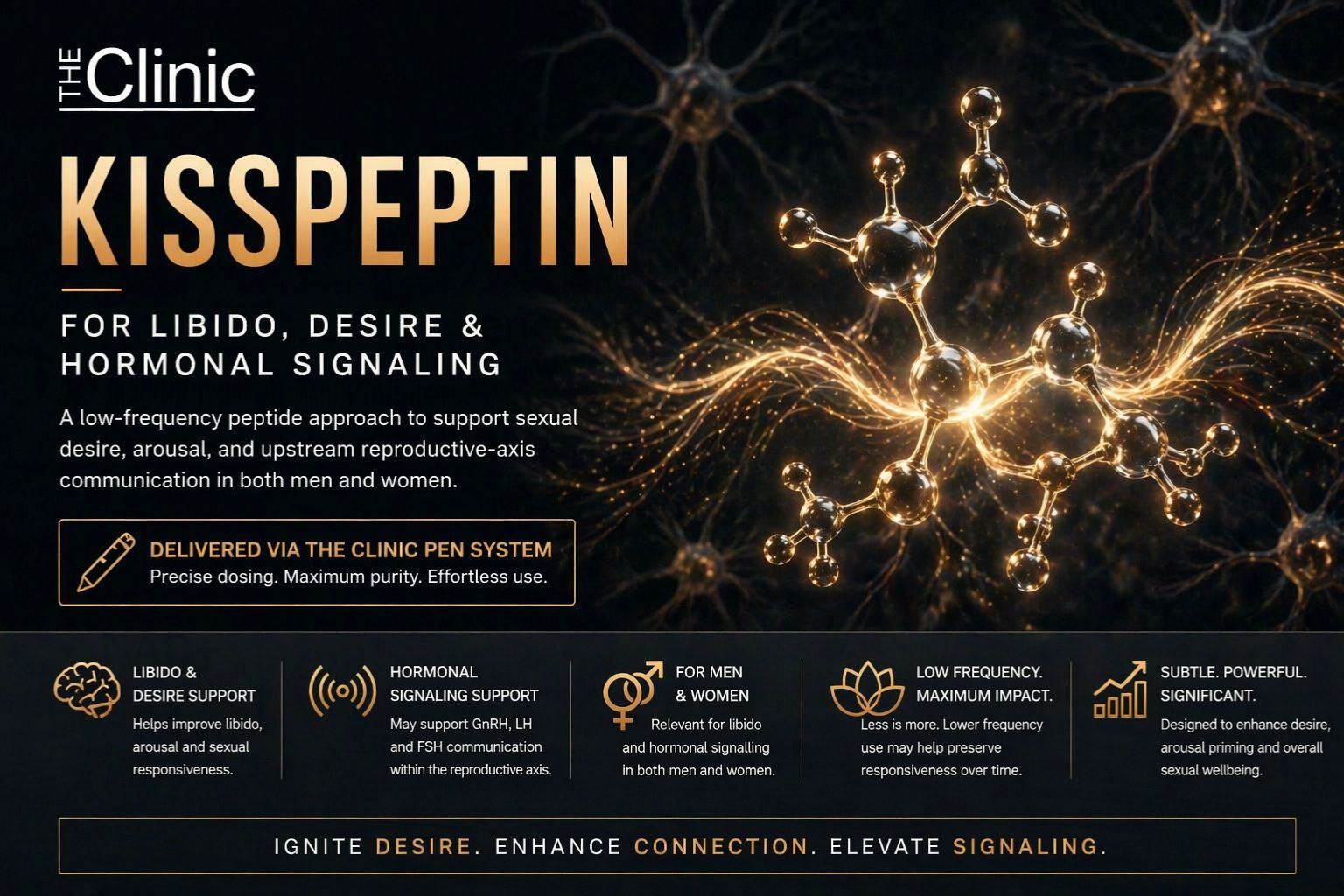
Kisspeptin is gaining attention as a peptide that may support sexual desire, arousal signalling, and upstream reproductive hormone communication. Rather than acting like a direct stimulant, it appears to work higher up in the chain, influencing the brain and hypothalamic signalling involved in libido, attraction, and reproductive hormone release.
For people exploring support for low desire, reduced sexual responsiveness, or flattened libido, Kisspeptin is often discussed as a more subtle and central option. It may be especially relevant for those who want to support the desire side of sexual function rather than only the physical-response side.
What Is Kisspeptin?
Kisspeptin is a naturally occurring signalling peptide involved in the regulation of the reproductive axis. It plays an important role in communicating with the hypothalamus, helping to trigger the release of GnRH, or gonadotropin-releasing hormone.
That then influences pituitary release of LH and FSH, which in turn affect the ovaries or testes and downstream sex hormone signalling.
In simple terms, the chain looks like this:
Kisspeptin → GnRH → LH / FSH → ovaries or testes → sex hormone signalling
This is why Kisspeptin is sometimes discussed not only for libido, but also for its potential role in hormonal communication and reproductive-axis support.
How Kisspeptin May Help
Kisspeptin is most often discussed in three main areas:
- libido and desire
- arousal signalling
- hormonal signalling
Libido and Desire
This is the strongest practical reason most people look at it.
Kisspeptin may help support:
- increased sexual interest
- improved mental engagement with intimacy
- greater responsiveness to erotic cues
- improved arousal priming
- a more noticeable sense of desire
Arousal Signalling
Kisspeptin is not best understood as a direct performance peptide.
Instead, it may help support the central signalling that leads into arousal, making the mind and body more receptive.
Hormonal Signalling
Because Kisspeptin acts upstream in the reproductive axis, it is also sometimes considered for its role in helping support:
- GnRH release
- LH and FSH signalling
- broader communication between brain and reproductive hormone pathways
That does not mean it should be presented as a guaranteed testosterone or oestrogen booster. The more accurate way to describe it is that it may support the signalling pathway that influences reproductive hormone activity.
Why Frequency Matters
One of the most important things about Kisspeptin is that more frequent use is not always better.
Kisspeptin signalling can become less responsive when exposure is too frequent. This is often described as desensitisation or tachyphylaxis. In practical terms, that means the response may fade if it is pushed too hard or used too often.
That is why Kisspeptin is often approached as a lower-frequency peptide, rather than something automatically used every day.
Suggested Usage and Frequency
Kisspeptin is best framed as a trial-based peptide, where the dose and frequency are kept conservative at first.
A practical starting approach is:
- start once weekly
- if clearly beneficial, consider twice weekly
- if response fades, reduce frequency or pause
- do not assume daily use is better
A useful way to approach it is to run a short trial phase, assess response, and only increase if there is a clear benefit.
Expected Outcomes
Kisspeptin is usually expected to produce a subtle to moderate effect, not a dramatic instant transformation.
The most realistic outcomes include:
- increased sexual interest
- improved desire
- better responsiveness to sexual thoughts, touch, or context
- easier mental engagement with intimacy
- improved arousal priming
Possible but less predictable outcomes may include:
- improved confidence around intimacy
- stronger erotic responsiveness
- better synergy when paired with a separate acute-response peptide such as PT-141
What It Is Not Best Suited For
Kisspeptin is not best understood as:
- a direct performance enhancer
- a guaranteed fix for broader menopausal symptoms
- a replacement for properly indicated HRT, testosterone therapy, or medical evaluation where those are needed
Kisspeptin for Women
For women, Kisspeptin is most relevant where the concern is:
- low sexual desire
- reduced arousal
- flattened responsiveness
- feeling mentally disconnected from intimacy
This makes it particularly interesting in women who feel that desire has gone quiet, or who want support on the mental and signalling side of arousal.
In peri-menopause or menopause, Kisspeptin may be most useful where the issue is desire and erotic responsiveness, rather than hot flushes or general hormone replacement needs.
Kisspeptin for Men
For men, Kisspeptin is often discussed where the goal is to support:
- libido
- desire
- sexual motivation
- central hormonal signalling
Because it acts upstream in the reproductive axis, some people also consider it in the context of testosterone-related signalling, although it should not be presented as a direct substitute for testosterone therapy.
Can Kisspeptin Be Paired With PT-141?
Yes. Conceptually, the two can make sense together because they appear to work in different lanes.
Kisspeptin supports the desire and arousal-priming layer.
PT-141 is more often viewed as the acute, occasion-based response layer.
That makes Kisspeptin a useful candidate for people who want support with wanting, while PT-141 may be more relevant when the goal is enhanced response in the moment.
Practical Expectations
Kisspeptin is probably best suited to someone who wants:
- a more thoughtful, central, desire-focused peptide
- support for libido rather than just performance
- a lower-frequency protocol
- a peptide that may sit at the intersection of libido and hormonal signalling
It is less suited to someone looking for a fast, intense, instantly obvious response every time.
Things to Keep in Mind
Kisspeptin is still best viewed as an emerging and exploratory option.
Response can vary from person to person. Frequency matters. Overuse may reduce responsiveness. Best results tend to come from conservative, thoughtful use rather than aggressive escalation.
Conservative Dosing and Frequency Approach
Because Kisspeptin may become less effective if used too frequently, a conservative, lower-frequency approach is usually the most practical place to begin.
A sensible structure is:
- start once weekly
- if clearly beneficial, consider twice weekly
- if response begins to fade, reduce frequency or pause before increasing again
A practical starting dose is usually kept in the low-to-moderate range, followed by assessment of desire, arousal, responsiveness, and overall benefit over several weeks.
The expected pattern is more likely to be a subtle increase in desire, arousal priming, and responsiveness to erotic cues than a dramatic instant effect.
It is generally better suited to a careful trial phase than aggressive daily use.
Summary
Kisspeptin is an interesting peptide because it bridges two areas people often care about: libido and hormonal signalling.
Its strongest practical use case appears to be support for:
- sexual desire
- arousal priming
- responsiveness to erotic cues
- upstream reproductive-axis communication
For both men and women, it is best presented as a low-frequency, carefully assessed peptide rather than something to be pushed aggressively.
In women, it may be especially relevant where desire has dropped off. In men, it may appeal where libido and central drive feel blunted. In both, its hormonal relevance comes from its role at the top of the signalling chain.
Used thoughtfully, Kisspeptin may offer a more nuanced way to support desire and sexual responsiveness, especially when the goal is not just performance, but the return of genuine interest, engagement, and arousal signalling.


